Ingredients
Equipment
Method
- Bring a large saucepan of water to a boil, deep enough to cover the eggs by about 1 inch. Lower the refrigerator-cold eggs in gently with a spoon. Keep the water at a gentle boil. I find that 12 minutes at sea level at a gentle boil is perfect for standard large eggs; start timing once the water returns to a gentle boil after adding the eggs. Very large eggs or high elevation may need longer. Prepare the ice bath while they cook, then transfer the eggs directly into it when the timer is up.
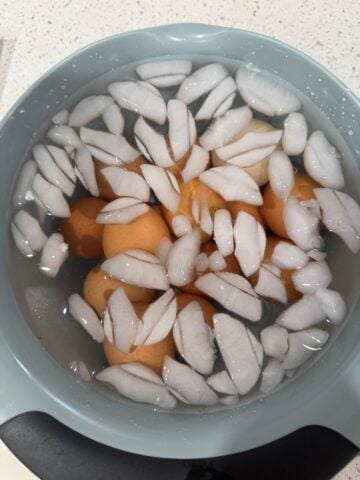
- Transfer the eggs straight into a large bowl of ice water. Cool for about 15 minutes, replenishing ice as needed, until cold throughout. Do not peel yet.
- Use the back of a clean spoon to tap gently all around each cooled egg, including the sides. Make a network of small cracks while leaving the shell on. Avoid knocking off large pieces or crushing the white.
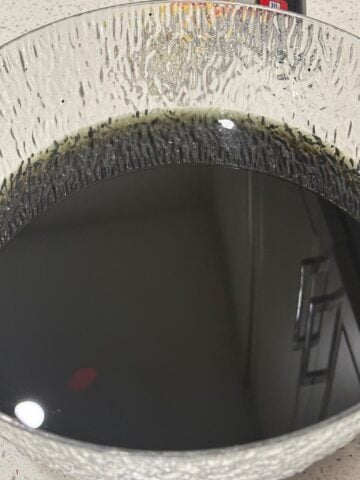
- In a clean food-safe container, mix cold drinking water with black food coloring until very dark, following the coloring label. Use enough solution to cover the eggs completely; about 4 cups is a starting point. Add the cracked, shell-on eggs, cover, and refrigerate at 40°F or below for 8–12 hours. Never leave the dye bath on the counter overnight.
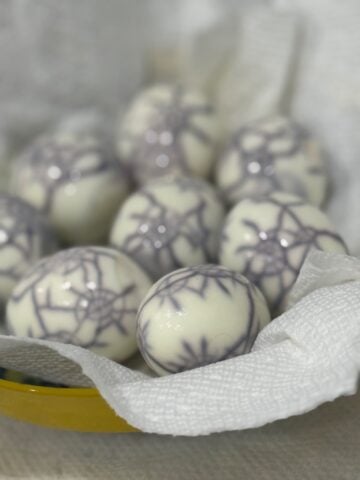
- Discard the dye solution. Peel the eggs gently, rinse briefly with cold drinking water to remove any shell fragments, and pat dry. Slice lengthwise. Collect all 12 yolks. Reserve both white halves from 1 egg for the filling, leaving 22 white halves to fill. Keep the whites chilled while you prepare the filling.
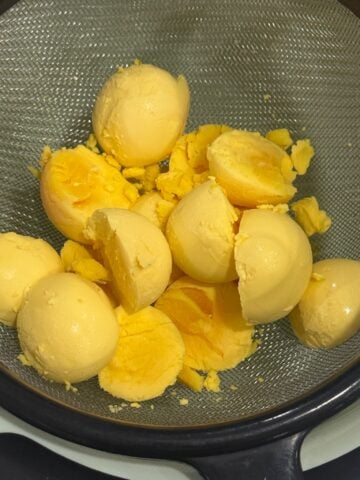
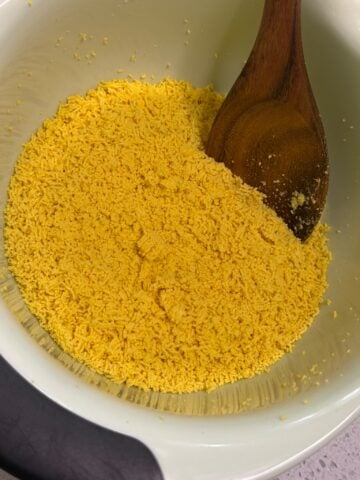
- Press all the cooked yolks through a fine-mesh sieve into a clean bowl with the back of a spoon. Finely chop the reserved pair of white halves and press them through the sieve into the same bowl too. Scrape the underside to collect the mixture. The yolks should be fine and free of lumps before adding the mayonnaise.
- Stir the sieved yolks with the mayonnaise, Dijon, vinegar and pepper until smooth. If desired, replace the vinegar with 1–2 teaspoons pickle juice, adding a little at a time. Fold in finely minced, well-drained jalapeños, if using. Taste before adding optional salt: mayonnaise, mustard, olives and pickled additions already contribute salt.
- Transfer the filling to a pastry bag fitted with a large round or open star tip, or snip a generous opening in the bag. Pipe generously into about 20 of the remaining 22 white halves. A couple of empty white halves are normal; refrigerate them separately for another use. For 22 pieces, distribute the filling more lightly. Mince jalapeños very finely and use a wide opening so they do not clog the tip.
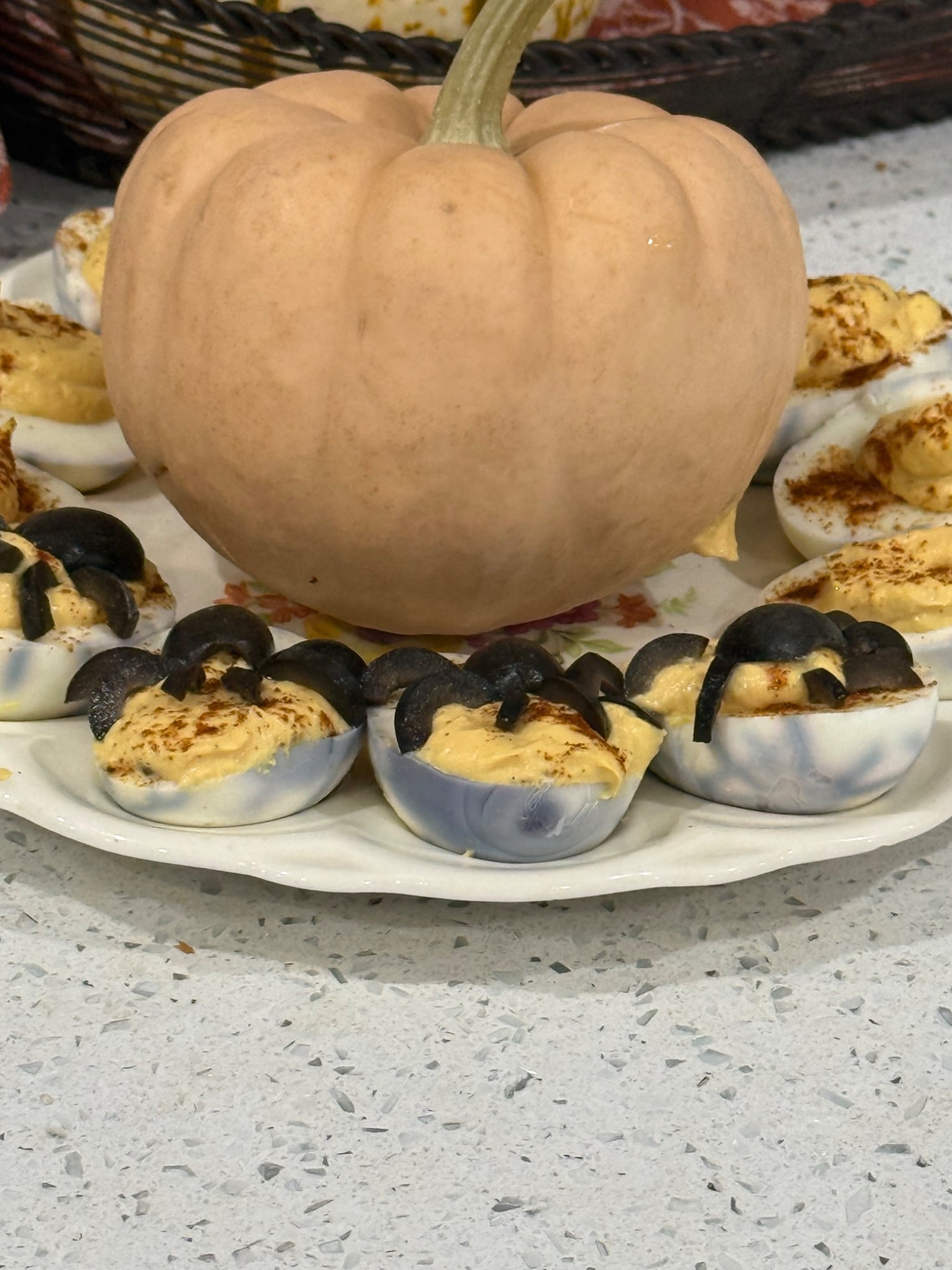
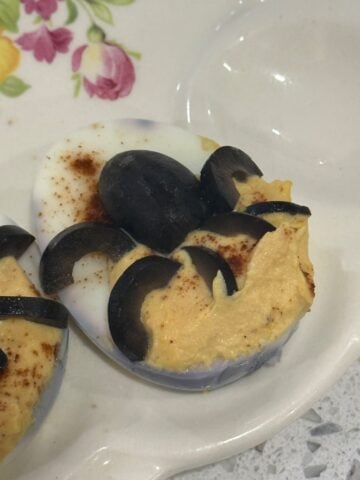
- Pat the olives dry. Halve 10 olives lengthwise for 20 spider bodies. Halve the remaining 20 olives lengthwise, then cut each half into 4 thin curved strips for 160 legs. Place one body and 8 legs on each filled egg, 4 on each side. Dust with paprika if desired. Chill until serving.
- Bring out a small tray at a time and keep the rest refrigerated. Keep eggs at 40°F or below on a properly iced tray; otherwise discard after 2 hours out of refrigeration, or 1 hour above 90°F.
Notes
Yield: About 20 generously filled halves from 12 eggs, using all 12 yolks plus both white halves from 1 egg in the filling. This leaves 22 halves to fill; a couple may remain empty with generous piping. For 22 smaller portions, spread the filling more lightly and allow 33 olives for the spiders.
Timing: Total shown includes a 15-minute ice bath and an 8-hour refrigerated soak; an overnight 12-hour soak adds 4 hours. Allow a little extra time to bring the water to a boil. For standard large eggs at sea level, use 12 minutes at a gentle boil, timed from when the water returns to a gentle boil. Very large eggs or high elevation may need longer.
Color: Concentrations vary by brand. The webs may look blue-gray or purple rather than jet black. Keep the shells on throughout the soak. Use only food-grade coloring and clean utensils.
Make ahead: Soak the night before, then peel and fill the next day. For best quality, eat assembled eggs within 2 days, kept covered at 40°F or below, and always within 1 week of boiling. Dyeing and filling do not restart the storage clock. Do not freeze.
Food safety: Refrigerate the entire overnight soak. Keep eggs cold during prep and service. Discard after more than 2 cumulative hours out of refrigeration, or 1 hour if above 90°F. The dye is decoration, not preservation.
Nutrition: Approximate per generously filled half, based on a 20-piece yield and excluding optional pickle juice, jalapeños and added salt. Brands, olive size and filling portions change the estimate.