
Some Christmas gifts are remembered long after the wrapping paper is gone. For Tom, that gift was Gramma’s almond roca. This homemade almond roca is made as a sheet of almond butter toffee, topped with chocolate and more almonds, then broken into pieces for sharing.
Jump to recipe · Variations · FAQs
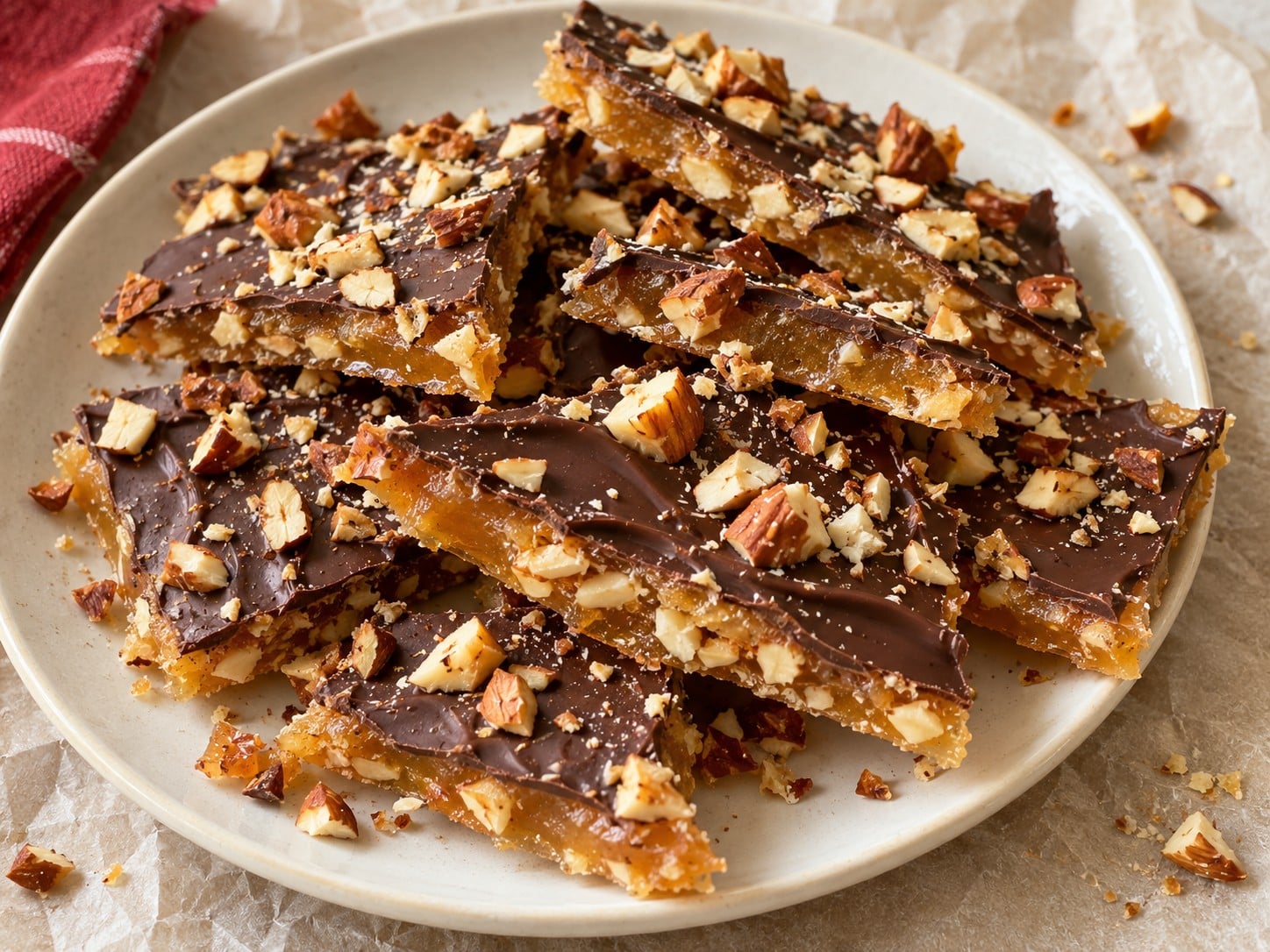
“We got it every year at Christmas, and if it lasted into January it was a surprise!” — Tom
That Christmas memory inspired this sheet-toffee version: buttery almond candy, a chocolate top and plenty of irregular pieces for the gift tin.
Part of Christmas, Cracked: Christmas candy and homemade gifts.
Why make this version?
- A sheet is easier to make at home than individually dipped pieces.
- A candy thermometer provides a clear stopping point.
- Toasted almonds go into the toffee and over the chocolate, so you get nuts throughout.
What you’ll need
- 1 cup unsalted butter — 227 g
- 1 cup granulated sugar — 200 g
- 3 tablespoons water — 45 ml
- 1 tablespoon light corn syrup — 21 g; helps discourage crystallization
- ¼ teaspoon fine salt
- 1 teaspoon vanilla extract
- 1 cup toasted almonds — 140 g; chopped, divided into ¾ cup (105 g) and ¼ cup (35 g)
- 8 ounces semisweet chocolate — 227 g; finely chopped
Almond roca versus Christmas crack
Both belong in a Christmas tin, but they are different candies. Almond roca is a solid butter-toffee sheet with almonds; it has no cracker base. Christmas crack uses crackers, a shorter stovetop cook and an oven finish. Follow the stopping point for the recipe you are making.
This homemade sheet version has chocolate on top, not a fully dipped shell around each piece. It is inspired by the familiar almond-toffee candy and is not affiliated with the commercial brand.
How to make it
- Prepare everything first. Line a 9 x 13-inch rimmed metal pan with a silicone mat or parchment rated for hot candy. Have the vanilla, chopped toasted almonds and chocolate measured before heating the sugar. Use a heavy 3-quart saucepan and a candy thermometer with its tip in the mixture but not touching the pan bottom. Keep children and pets away from the hot sugar.
- Dissolve and combine. Add the butter, sugar, water, corn syrup and salt to the saucepan. Heat over medium-low, stirring gently, until the butter has melted and the mixture is uniform with no dry sugar pockets. Do not rush this stage with high heat.
- Cook to hard crack. Increase to medium and maintain a steady, controlled boil, stirring slowly along the bottom to prevent scorching. Keep dried sugar crystals on the sides out of the mixture. Cook until the thermometer reaches 300°F (149°C) at sea level; this may take roughly 12–20 minutes after heating begins, but temperature is the guide. The mixture should be a deep golden amber. Watch closely near the end and remove from the burner immediately at the target.
- Add almonds and pour. Carefully stir in the vanilla—it will bubble—then the ¾ cup (105 g) portion of toasted almonds. Immediately pour into the prepared pan and spread into a thin sheet, about ¼ inch thick. Do not scrape crusted residue from the saucepan onto the candy. Never touch or taste the hot mixture.
- Top with chocolate. Wait 2–3 minutes for the surface to begin setting while the slab remains hot. Scatter the finely chopped chocolate evenly over the top, wait another 2–3 minutes, and spread gently when soft. If the chocolate will not spread, melt it separately at 50% microwave power in short bursts rather than overheating the toffee. Sprinkle with the remaining ¼ cup (35 g) almonds and press lightly with a dry spoon.
- Cool and break. Cool undisturbed until the slab is firm and the chocolate has set, about 90 minutes or longer in a warm room. Once the pan is no longer warm, a brief refrigerator chill can help finish setting. Lift out, remove the liner, and break into about 32 small pieces. If very cold, let it stand a few minutes before breaking to reduce chocolate separation.
Why a thermometer matters
For this formulation, the sea-level target is 300°F (149°C). Color helps, but it is not a substitute for a working thermometer: lighting, saucepan color and burner strength vary. Keep the tip off the metal bottom, use a thermometer rated for candy temperatures, and check it against boiling water before beginning.
At elevation, water boils at a lower temperature, so the candy target also needs adjustment. As a starting rule, reduce the target by the difference between your local boiling point and 212°F; for example, a 208°F local boiling point suggests a 296°F candy target. Distinguish elevation from a faulty thermometer. See Colorado State University Extension’s high-elevation guidance for background.
Variations to try
- Dark chocolate espresso: Use 8 ounces (227 g) dark chocolate around 60% cacao and add ½ teaspoon instant espresso powder with the sugar. Keep the butter-to-sugar ratio unchanged.
- Pistachio roca: Replace the almonds by weight with 140 g roasted shelled pistachios, keeping the same 105 g/35 g split. This is pistachio toffee rather than almond roca.
- Milk chocolate: Use 8 ounces (227 g) milk chocolate instead of semisweet for a sweeter finish; it will soften more readily in a warm room.
- Dairy-free: Butter formulation matters in hard toffee. To try a dairy-free version, use 227 g dairy-free baking sticks containing about 80% fat and dairy-free chocolate. Avoid soft tub spreads; the candy’s texture and setting can vary with the brand. For a simpler dairy-free gift, try chocolate bark with dairy-free chocolate and suitable toppings.
Make-ahead and gift tins
Make the toffee within a week of gifting. Store airtight in a cool, dry place, or refrigerate if the room is warm enough to soften the chocolate. Use parchment between layers and enjoy within 2 weeks for best quality.
Let a refrigerated, sealed container warm gradually before opening so condensation does not collect on the candy. Plan on six to eight small pieces for a modest gift, and pack peppermint sweets separately. Include a label listing almonds, milk and any soy in the chocolate, plus the other ingredients and the date made.
Gift tins and packing supplies
Affiliate links: As an Amazon Associate, we earn from qualifying purchases.
Affiliate disclosure: As an Amazon Associate I earn from qualifying purchases.
For a small run of gifts, compare Landhoow’s 6-pack Christmas tins with window lids. For a longer recipient list, compare Yaomiao’s 12-pack of 5.3-inch Christmas cookie tins. Choose the selected size and design before ordering; current price, stock and delivery dates are on Amazon.
Line each tin with an inner food-safe bag or use a sealed food container inside it. Decorative lids are not a guarantee of an airtight seal. Add parchment between layers and leave cushioning space; the candy yield does not promise to fill a particular tin.
Frequently asked questions
Why is my almond roca soft or chewy?
The mixture may not have reached the correct hard-crack temperature, or the thermometer may have touched the bottom and read too high. Check the thermometer and use the altitude-adjusted target. Moist storage can also soften candy. Cooling longer helps only if it was cooked correctly.
Why did my toffee turn oily?
Butter separation can happen with uneven heating, sudden temperature changes or an unstable mixture. Use a heavy saucepan and moderate heat, and combine the ingredients gently before the boil. Do not assume an oily mixture will fix itself after pouring. Avoid adding water to very hot candy as an improvised rescue; it can splatter.
Can I skip the corn syrup?
It is a small amount intended to reduce crystallization in this version. Omission or substitution changes how the candy crystallizes. Honey and maple syrup bring different sugars, water and flavor, so they are not automatic replacements.
Can I make it without a thermometer?
Experienced candy makers can use a cold-water test, but a thermometer is the recommended approach for this recipe. A fixed number of minutes or a brown-paper-bag color comparison is too dependent on your pan, burner and lighting to be our only instruction.
Can I use raw almonds?
Toast and cool them first. Spread chopped almonds on a separate tray at 325°F (165°C) and check frequently, stirring once, until lightly golden and fragrant, usually about 7–10 minutes. Oven strength and piece size matter. Cool before measuring the portions for the candy.
How do I clean the saucepan?
Let it cool until safe to handle, then fill with hot water and let the hardened sugar dissolve. Do not pour cold water into a pan of very hot sugar or scrape it with your hands.
More Christmas candy to share
- Classic Christmas Crack
- Peppermint Christmas Crack
- Dubai-Style Christmas Crack
- Salted Dark Chocolate Bark
- Crock Pot Crack Candy
Recipe card
Gramma’s Almond Roca (Homemade Sheet Toffee)
Ingredients
Equipment
Method
- Line a 9 x 13-inch rimmed metal pan with a silicone mat or parchment rated for hot candy. Have the vanilla, chopped toasted almonds and chocolate measured before heating the sugar. Use a heavy 3-quart saucepan and a candy thermometer with its tip in the mixture but not touching the pan bottom. Keep children and pets away from the hot sugar.
- Add the butter, sugar, water, corn syrup and salt to the saucepan. Heat over medium-low, stirring gently, until the butter has melted and the mixture is uniform with no dry sugar pockets. Do not rush this stage with high heat.
- Increase to medium and maintain a steady, controlled boil, stirring slowly along the bottom to prevent scorching. Keep dried sugar crystals on the sides out of the mixture. Cook until the thermometer reaches 300°F (149°C) at sea level; this may take roughly 12–20 minutes after heating begins, but temperature is the guide. The mixture should be a deep golden amber. Watch closely near the end and remove from the burner immediately at the target.
- Carefully stir in the vanilla—it will bubble—then the ¾ cup (105 g) portion of toasted almonds. Immediately pour into the prepared pan and spread into a thin sheet, about ¼ inch thick. Do not scrape crusted residue from the saucepan onto the candy. Never touch or taste the hot mixture.
- Wait 2–3 minutes for the surface to begin setting while the slab remains hot. Scatter the finely chopped chocolate evenly over the top, wait another 2–3 minutes, and spread gently when soft. If the chocolate will not spread, melt it separately at 50% microwave power in short bursts rather than overheating the toffee. Sprinkle with the remaining ¼ cup (35 g) almonds and press lightly with a dry spoon.
- Cool undisturbed until the slab is firm and the chocolate has set, about 90 minutes or longer in a warm room. Once the pan is no longer warm, a brief refrigerator chill can help finish setting. Lift out, remove the liner, and break into about 32 small pieces. If very cold, let it stand a few minutes before breaking to reduce chocolate separation.

Tried the recipe? I'd love to hear your thoughts below!